

Gate 38 in Human Design is known as the Gate of the Fighter and is associated with purpose, resilience, and standing up for what matters. If this gate is activated in your chart, you may feel a deep drive to fight for meaning and engage with challenges that feel worth your energy. This energy is not about conflict for the sake of it, but about discerning what is truly important and committing to it with determination.
In this guide, we’ll start with a brief overview of what gates are in Human Design and how they show up energetically in your chart. You’ll also learn the difference between red (unconscious), black (conscious), and striped (both) activations, along with how these influence your experience of the gate. From there, we’ll explore the high and low expressions of Gate 38 and how this energy can show up in everyday life.
Finally, we’ll take a closer look at the Personality Sun placement and what it means if Gate 38 is your Personality Sun gate — highlighting how themes of purpose, resilience, and meaningful struggle may shape your identity and life path.
If you’re new to Human Design or want to see how Gate 38 fits into your overall chart, you may want to start with the Human Design Guide, where you can explore how your energy type, strategy, authority, profile, centers, channels, and gates all work together.
Return to the Gates Guide Page to explore other gates in your chart.
what are the gates in human design?
- The Gates in a Human Design body graph represent the gifts, talents, motivations, energetics, or drives that are consistently available to us. If you DO NOT have a gate activated or colored, it doesn’t mean you never have access to that energy. It just means it’s not a reliable or constant source of energy in your life.
- Everyone has the potential for 26 individual gates to be activated in their bodygraph chart; however, if you look closely, you may find that some gates appear multiple times in the two columns on either side of the chart. This is a common occurrence.
- There are 64 Gates in a bodygraph chart, and each gate has a theme that is related to the 64 I Ching hexagrams. If you would like a deeper understanding of the gates, I highly recommend deep diving into the Chinese I Ching hexagrams.
- Lastly, it is worth noting that there are MANY layers to all aspects of the chart, including the gates. This article is intended to be a high-level summary.
how the gates can show up energetically in our lives
- We can use the energy of a gate in a positive or negative way towards ourselves and/ or other people.
- We may embody the energy with lack and/or fear, or we can embody the energy with truth and abundance.
- Because of external conditioning, we may shy away from the energy and choose NOT to see it as part of ourselves. We may not want to embrace it; we may instead shut it down.
what does a black line vs. a red line vs a striped line mean?
- Black Lines represent gifts that we are likely more conscious and aware of.
- Red Lines represent gifts that we are likely less conscious of and aware of.
- Striped (both black and red) lines represent gifts that are both conscious and unconscious.
stop piecing together your human design chart
Instead of jumping between articles, the Aligned by Design Bundle teaches you how to read your full chart in one clear, easy-to-follow framework.
gate 38 – gate of the fighter
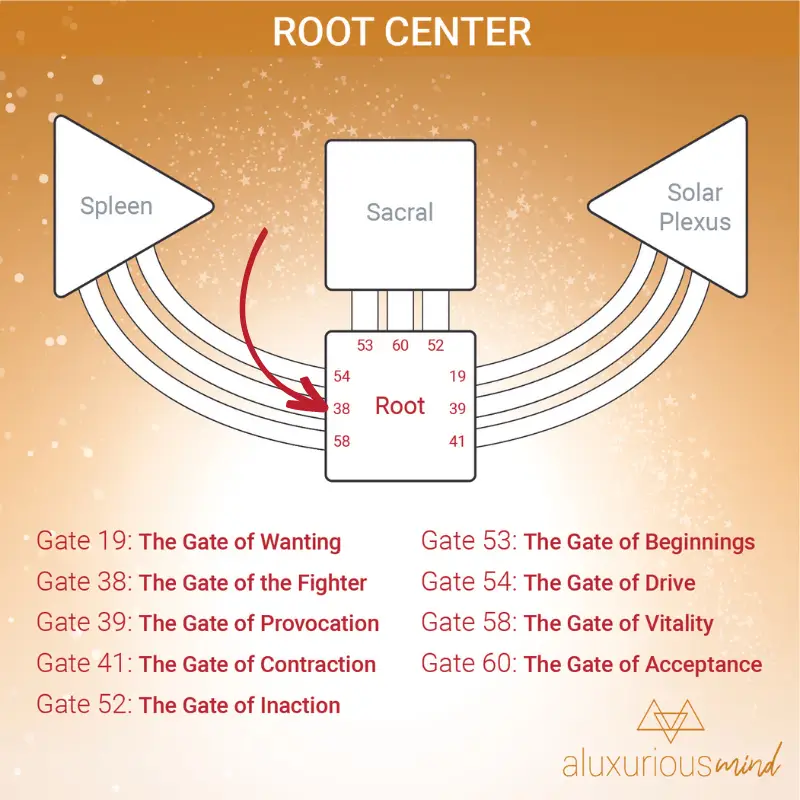
Gate 38 lives in the Root Energy Center, which is a motor or pressure center – it is designed to kick start or initiate things.
high expression of gate 38
- People with this energy know what is worth fighting for and they are NOT interested in just “surviving”. They are here to seek and find meaning in life by finding out what is worth struggling for. Discovering the reason for existing that elevates their struggles beyond simply surviving.
- You have a strong buffer when “shit hits the fan”. You are designed to have the energy to confront adversity, and this is enhanced when you are standing up for others who can’t stand up for themselves. You have a fierce independence and stubbornness that help you meet challenges head-on.
challenge side of gate 38
- Getting into fights just because.
- Being stubborn and/or engaging in the wrong struggles so that everything feels harder for you.
- Struggling for the sake of “struggling” or getting into arguments just for the sake of it.
the channel of struggle – gate 38’s partnership with gate 28
- Gate 28 listens with instinctive awareness for which risks and challenges are energetically correct for Gate 38 to take on, so it can relish in a “good fight” and do more than “just survive”.
is gate 38 your “personality sun gate”?
what is a personality sun gate?
- Personality Sun Gate is the top number located in the Personality Side of the chart. If you are looking at the bodygraph chart, you will see two columns on either side. The column on the right is the Personality side. The number at the top is your Personality Sun Gate.
- Many say that your Personality Sun Gate is 70% of your energy – it is the thing you are here to do and share with the world. The energies of this gate will be expressed throughout your life journey and the work you choose to do.
- It is worth noting that we often see our Personality Sun Gate as a flaw earlier in life and then later embrace it as a gift.
gate 38 as your personality sun gate
- If Gate 38 is your Personality Sun Gate, it means you are here to engage in the correct challenges in life that will make you feel alive and bring meaning to your life. If you lean into your strategy and authority, you will naturally bring this gift into the things you are passionate about. The way this energy will express itself will be unique to you.
artist attribution
- Featured image photo by Lili Popper on Unsplash
references
- The Definitive Book of Human Design: The Science of Differentiation by Lynda Bunnell and Ra Uru Hu
- Jenna Zoe myhumandesign.com Level 1 – 3 Reader Trainings
- Incarnation Cross: A Guidebook of Purpose Archetypes by Brynja Magnusson
disclaimer
As an Amazon Associate I earn from qualifying purchases. Some links on this blog post may be affiliate links that can result in small commissions & help support the site.
(function(w, d, t, h, s, n) { w.FlodeskObject = n; var fn = function() { (w[n].q = w[n].q || []).push(arguments); }; w[n] = w[n] || fn; var f = d.getElementsByTagName(t)[0]; var v = ‘?v=’ + Math.floor(new Date().getTime() / (120 * 1000)) * 60; var sm = d.createElement(t); sm.async = true; sm.type = ‘module’; sm.src = h + s + ‘.mjs’ + v; f.parentNode.insertBefore(sm, f); var sn = d.createElement(t); sn.async = true; sn.noModule = true; sn.src = h + s + ‘.js’ + v; f.parentNode.insertBefore(sn, f); })(window, document, ‘script’, ‘https://assets.flodesk.com’, ‘/universal’, ‘fd’); window.fd(‘form’, { formId: ’67e5a175698fa8afc4f4d6b0′ });