

Human Design can be a helpful tool for understanding career alignment because it gives you insight into how you are naturally designed to use your energy, make decisions, and interact with work. This does not mean there is only one perfect job for each energy type, or that certain types can only do certain careers. Any energy type can do any job. The value of Human Design is not in boxing you in — it is in helping you understand your work style, your needs, and why a role may feel energizing, sustainable, or draining.
This information is especially useful if you feel unhappy, stuck, or unable to put your finger on why your current job or career path does not feel right. On the other hand, if you are already happy in your work, that matters too — there may be no reason to change anything until you genuinely feel called to. In this article, we’ll explore how Human Design applies to career, the work styles of each energy type, how to choose a path that feels more aligned, and the difference between career alignment and chasing a mythical “perfect job.” We’ll also look at how to apply this in real life in a practical, flexible way.
If you’re new to Human Design, the Human Design Guide is a great place to start for a broader understanding of your chart. And because strategy and authority are the real foundation of alignment in both life and work, the Strategy and Authority Guide is an especially important companion to this conversation.
how human design influences to career
Unfortunately, Human Design does not tell us exactly what we should be when we “grow up” or point to one fixed career path. It does not say you are destined to be a writer, lawyer, coach, or any other single thing. It also does not decide your passions or interests for you. Your bodygraph is not meant to be read in a rigid or prescriptive way, because you are not designed to be only one thing.
What Human Design can tell us is the kind of energy you bring to your work, your passions, and the things you love to do. It can show you the gifts, strengths, and themes you naturally carry into your career. For example, if you have a lot of correction energy in your chart, you may naturally bring discernment, refinement, or problem-solving into whatever work you do. These are the qualities you bring to the table, regardless of the job title.
Human Design can also help you understand your energy type, which gives clues about your natural work style and how your energy is designed to function. Your strategy and authority are especially important because they show you how to make aligned decisions about work, opportunities, and timing. In many ways, these are more useful than trying to force yourself into a “perfect” career box, because they help you recognize what is actually correct for you in real life.
Beyond that, Human Design can offer insight into how much structure or flexibility is supportive for you, as well as light clues about the kinds of environments where you may work best. Some people thrive with more routine, consistency, and predictability, while others do better with variety, movement, and freedom. Together, these pieces can help you better understand not necessarily what career to choose, but how you are designed to work in a way that feels more natural, sustainable, and aligned.
best work styles by energy type
Let’s walk through the five different energy types and explore each energy type’s energetic relationship with its livelihood.
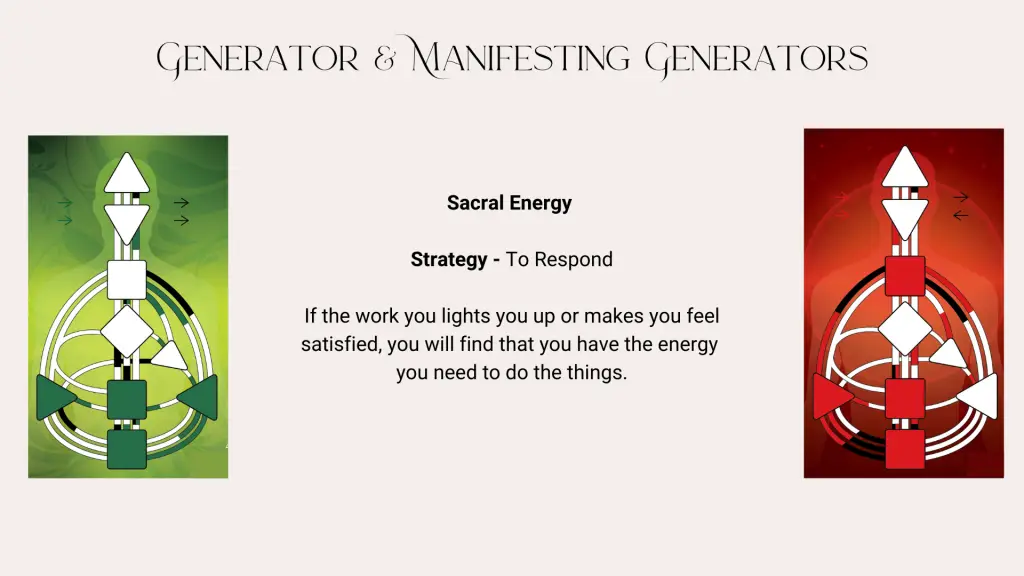
generator and manifesting generator energy type
Generators and Manifesting Generators thrive when they are deeply engaged in work that feels satisfying. Because both types have Sacral energy and the strategy to respond, the biggest clue that a job or career is energetically aligned is the signature of satisfaction. If they consistently feel energized, fulfilled, and like their work is giving something back to them, that is a strong sign they are in the right place. If they feel chronically frustrated, drained, or stuck, that is often a sign that something is off.
This is why satisfying work matters so much for these two types. When Generators and Manifesting Generators are doing work they enjoy, their life force energy turns on. When they are stuck in work that feels flat, forced, or misaligned, they are far more likely to burn out over time. That does not mean they need a fantasy job or nonstop passion every second of the day, but it does mean their work should contain enough engagement, interest, and response to keep their energy moving.
Rather than focusing on a specific job title, it is more helpful to think about roles and work styles. Generators often do well in roles where they can build mastery, create momentum, and stay engaged with meaningful work over time. Manifesting Generators may especially thrive in roles that allow variety, movement, multitasking, innovation, or the freedom to pivot as their interests evolve.
For both types, the biggest trap is making career decisions based on logic and how much money they will make. This can quickly get them into a situation where they burn out, feel stuck, and frustrated with life. NOTE – there may be an exception to this rule depending on your unique bodygraph chart.
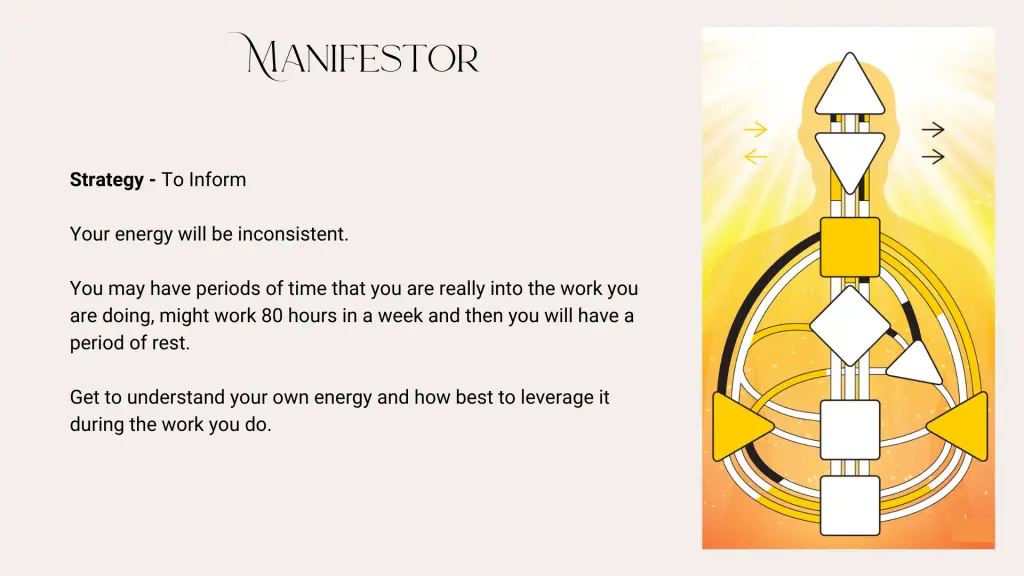
manifestor energy type
Manifestors tend to do best in work that allows for independence, autonomy, and the freedom to initiate. Their strategy is to inform, which means they are designed to let people know what they are doing, thinking, or moving toward so their energy can flow with less resistance. Because Manifestors do not have a defined Sacral Center, their work energy is not meant to be consistent in the same way as Generators. They may have powerful bursts of energy to start, lead, or move something forward, followed by periods where they need more rest or space.
This is why career alignment for a Manifestor is often less about finding a perfectly “passionate” job and more about finding work that respects their natural rhythm and need for self-direction. Manifestors usually do well in roles where they can initiate, create, lead, innovate, or work with a greater sense of freedom rather than being overly managed or forced into constant output. They may have seasons of intense productivity and then need time to pull back, reset, and wait for the next urge. The key is learning how their energy works or cycles and not judging themselves when their energy feels inconsistent.
Another important clue for Manifestors is their signature of peace. When a job, role, or career path is aligned, there is often a greater sense of inner peace, freedom, and reduced resistance. When it is not aligned, anger, frustration with control, or feeling boxed in may start to build. For many Manifestors, the most supportive work environments are the ones that give them room to move independently, communicate what they are doing, and trust their own creative urges.
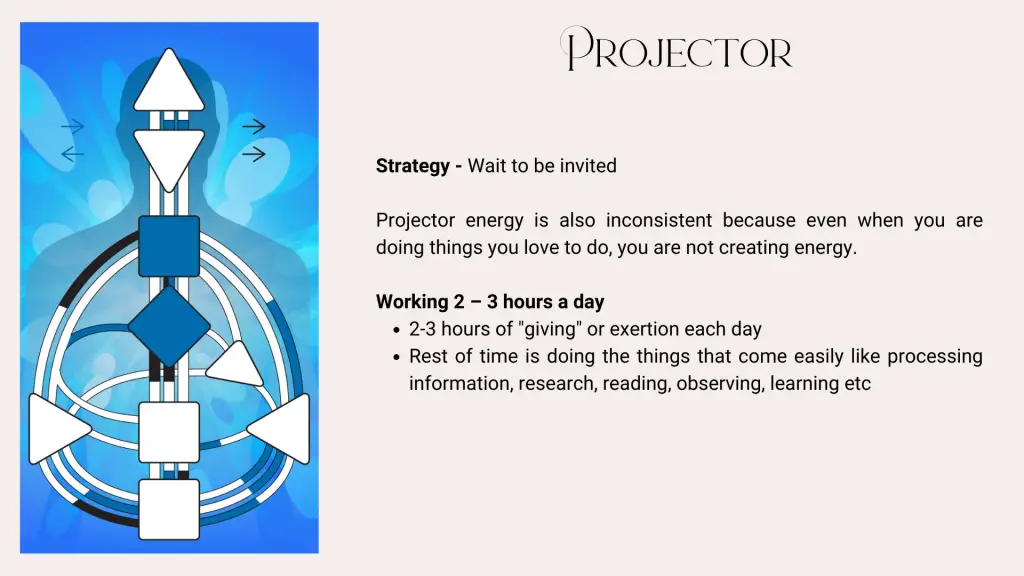
projector energy type
Projectors are not built for constant output, which is why career alignment often has more to do with how they work than with any one job title. Because Projectors do not have a defined Sacral Center, even work they enjoy can be draining if they push too hard or ignore their natural energy patterns. This does not mean Projectors cannot work full-time or be successful. It means they need to be more aware of which tasks feel heavy and depleting versus which ones feel easier, more natural, and sustainable.
Projectors often thrive in guidance roles — work that involves advising, directing, seeing systems, improving processes, mentoring, strategizing, or helping others use energy more effectively. They are often gifted at identifying inefficiencies and offering insights that can move things forward. Recognition is also important. Projectors tend to do best when their strengths are seen, valued, and invited in, rather than when they are constantly trying to prove themselves through effort alone.
In practical terms, Projectors may do well by identifying their “heavy” tasks and being intentional about how much of that kind of work they take on each day. Meetings, nonstop people interaction, or long periods of exertion may drain them quickly, while strategy, observation, research, problem-solving, and focused guidance may feel much more sustainable. The key is not obsessing over hours, but learning your own energy budget, building in recharge time, and creating a work style that honors your rhythm rather than comparing yourself to more consistently energetic types.
reflector energy type
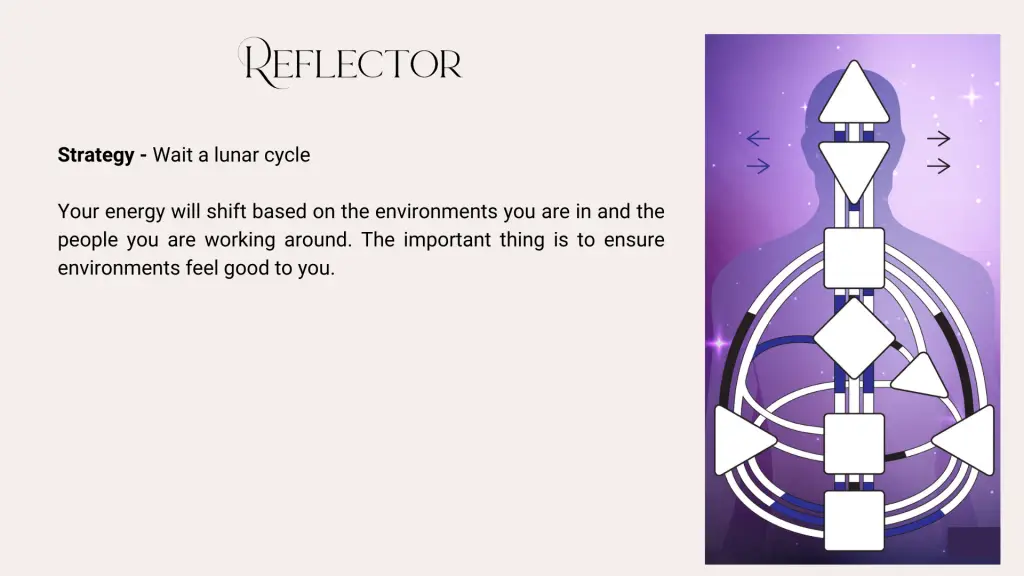
Reflectors are especially sensitive to their environment, so the people they work with and the spaces they work in can have a major impact on how they feel. Because all of their centers are open, they take in and reflect the energy around them, which means the same job can feel very different depending on the environment, leadership, team dynamics, or overall atmosphere. For Reflectors, career alignment is often less about forcing a fixed identity and more about finding places that feel healthy, supportive, and energetically correct.
This is why Reflectors often do best in flexible roles and environments that give them room to move with their changing energy. When considering a job, it is important to pay attention to the overall vibe — not just the position itself. A Reflector may feel energized, pressured, calm, inspired, or drained based on who they are around, and that information matters. Rather than judging themselves for changing, Reflectors can benefit from understanding that they are naturally responsive to their environment. The more they honor this sensitivity and choose workplaces that feel good to their system, the more supported and aligned they tend to feel.
how to choose the right career or job using human design
Human Design is most helpful for career decisions when you use it as a tool for alignment rather than a rigid rulebook. (Let’s not be dogmatic!) The goal is not to force yourself into a job title that someone says matches your chart. The goal is to better understand how you make decisions, how your energy works, and what patterns show up when something is or is not right for you.
The first step is to follow your authority. Your authority is your internal decision-making system, and it matters more than any generic career advice. A job may look great on paper, make logical sense, or impress other people, but if it is not correct for you energetically, you will usually feel it over time. Your authority helps you know whether an opportunity is actually aligned, rather than just attractive, practical, or familiar.
The second step is to notice your energy patterns. Pay attention to how your body and energy respond to different kinds of work, environments, people, and responsibilities. Do you feel satisfied, peaceful, recognized, or surprised in a good way? Or do you feel frustrated, bitter, angry, or disappointed? Notice what parts of your work energize you, what drains you, what feels sustainable, and what consistently feels heavy. These patterns often tell you more than logic alone.
The third step is to experiment. Your strategy and authority are something you test or play with in real life. You do not need to have your whole career mapped out before making a change. Sometimes the most helpful thing you can do is try small adjustments — change the kind of tasks you take on, explore a different work environment, reduce what drains you, or say yes to opportunities that feel more aligned. Career clarity often comes through lived experience, not through trying to figure everything out perfectly in advance.
go deeper into your relationship with money
I’m considering an updated version of Unlock Your Money Code, a resource designed to help you explore money, abundance, and alignment through astrology and Human Design. Join the waitlist to be notified if/when it becomes available.
common career mistakes based on energy type
One of the biggest career mistakes people make with Human Design is using their mind or logic to make decisions that are not actually aligned with their energy. While any energy type can do any job, each type tends to have certain “traps” that can create frustration, burnout, or dissatisfaction when ignored.
Generators and Manifesting Generators often get into trouble when they choose work based only on money, security, or what looks good on paper, while ignoring whether the work actually feels satisfying. They may also stay too long in roles that no longer light them up and try to push through out of obligation. For these types, a major mistake is overriding their Sacral response and treating themselves as if they could force energy where there is no real engagement.
Manifestors often struggle when they take jobs that are overly controlling, heavily micromanaged, or leave no room for independence. Another common mistake is trying to match the steady output of Sacral types and then judging themselves when their energy comes in waves. Manifestors can also create unnecessary resistance when they do not inform others of what they are doing, which can make work relationships harder than they need to be.
Projectors often mistake their worth for productivity and try to keep up with the Generator energy types around them. They may overwork, stay in draining environments too long, or take on too many heavy tasks that exhaust them quickly. Another common mistake is ignoring where they are truly recognized and instead trying to prove their value through effort alone, rather than leaning into their natural guidance and insight.
Reflectors often struggle when they ignore the importance of environment and stay in workplaces that feel energetically off. They may also try to lock themselves into a fixed professional identity when their experience is naturally more fluid and responsive to the people around them. A major mistake for Reflectors is dismissing their feelings in a space and trying to power through an environment that consistently leaves them depleted.
Across all energy types, the common thread is this: career misalignment often happens when you ignore your natural energy patterns, override your authority, and try to work like someone you are not. The more you understand your type and honor how your energy is actually designed to function, the easier it becomes to make career choices that feel sustainable and aligned.
career alignment vs. the “perfect job“
Human Design is not here to help you find one single, perfect job that you are destined to do forever. It is much more useful than that. It helps you understand alignment — the conditions, work styles, environments, and decision-making patterns that support your energy and your career, regardless of the exact title.
This matters because many people get stuck thinking there must be one right answer, one dream job, or one ideal path that will solve everything. But in reality, there may be many careers, roles, or business models that could work well for you. The question is less, “What is the one perfect job for me?” and more, “Does this work allow me to operate in a way that feels aligned with my energy?”
A job can be imperfect and still be aligned enough for the season you are in. And a job can look amazing on paper but still feel wrong in your energy (body). Human Design helps you focus on what supports you — your energy, your authority, your work style, and your needs — so you can make better decisions without getting trapped in the idea that there is only one possible outcome.
how to apply this information to your career
You do not need to quit your job or completely reinvent your life overnight to use Human Design in a practical way. In many cases, the most helpful approach is to make small adjustments based on what you are learning about your energy. That might look like changing how you structure your day, reducing certain draining tasks, asking for more flexibility, building in more rest, or paying closer attention to which parts of your work actually feel good.
The real value often starts with awareness. Notice what energizes you, what consistently drains you, what kinds of opportunities feel correct, and what leaves you frustrated, bitter, angry, or disappointed. Pay attention to your natural rhythms, the types of tasks that feel sustainable, and how your body responds to different work demands. This kind of awareness can help you make better career decisions over time, even before any big external change happens.
It is also important to look at your environment. Sometimes a role is not the real problem — the setting is. The people around you, the pace, the structure, the amount of stimulation, or the physical and virtual environment may be impacting you more than you realize. Human Design can help you become more intentional about the conditions you work best in, so you can create a career that feels more supportive, sustainable, and aligned from the inside out.
personality sun gate, and the incarnation cross
If you want to go a layer deeper, your Personality Sun gate and Incarnation Cross can add more context to your career path. Your Personality Sun gate highlights a core energy you are here to express, which can shape the themes, strengths, and perspective you naturally bring to your work. Your Incarnation Cross adds an even bigger layer by pointing to your broader life theme and the kinds of contributions or experiences that may feel especially meaningful over time.
These pieces are not meant to box you into a specific profession, but they can offer helpful clues about the deeper purpose behind the work you do and the impact you are here to make. If you want to explore this in more detail, visit the Incarnation Cross Guide.
artist attribution
- Featured image Photo by Danyu Wang on Unsplash
references
- The Definitive Book of Human Design: The Science of Differentiation by Lynda Bunnell and Ra Uru Hu
- Jenna Zoe myhumandesign.com Level 1 – 3 Reader Trainings
disclaimer
As an Amazon Associate I earn from qualifying purchases. Some links on this blog post may be affiliate links that can result in small commissions & help support the site.
