

If you are a Projector with G-Center Authority, this article is for you! So I had an idea to create a decision flowchart for each of the human design energy types and their authority, but before I do, it is important to note that I am taking a very nuanced topic and simplifying it into a flowchart. Please know that this subject can be complicated.
In the article below, I intend to show how our decision-making process works, step-by-step, when we lean into our strategy and authority. I want to show how our strategy and authority work together, and the flow chart provides a simple snapshot of how this process works (in a perfect situation, of course).
If you’re new to Human Design, start with the Human Design Guide to understand the foundational concepts before diving deeper into this decision-making style.
For more information on Strategy and Authority, refer to the Strategy and Authority Guide.
If you prefer to explore this topic in a video format, you will find a link to the YouTube video below.
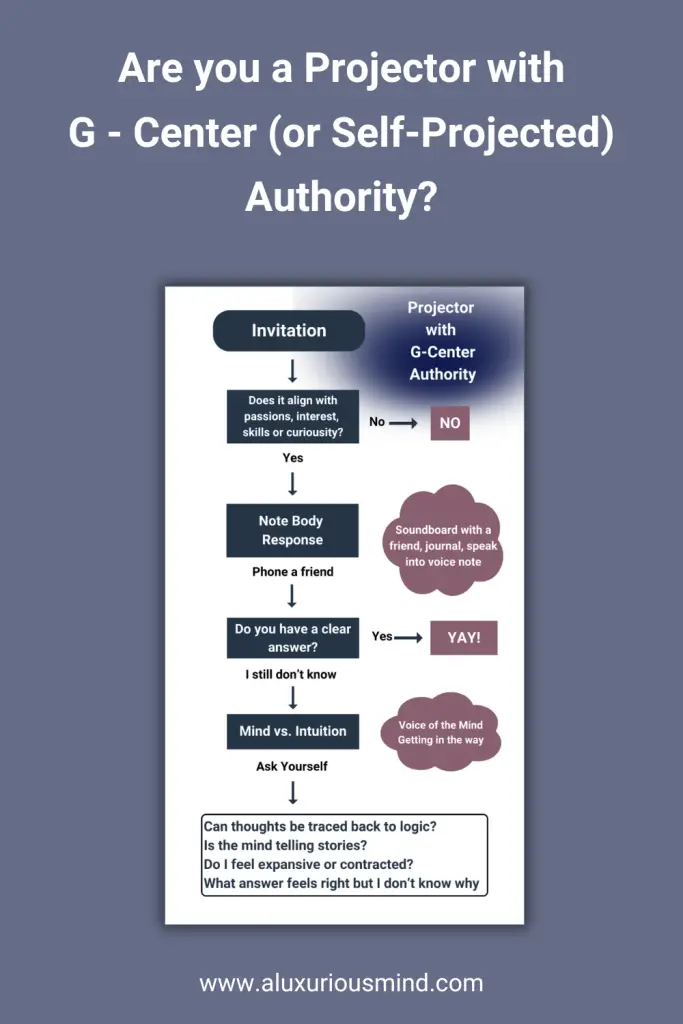
background – making decisions through human design
When you are presented with an opportunity or a choice in life – how do you know what the right decision is for you? How do you know if something is in alignment for you?
This is why the most important aspect of a Human Design chart is your Energy type strategy and authority. Your “Strategy” is how you are designed to use your energy, and your “authority” is the way you gain clarity to make decisions. These two aspects do not work in a silo – they work together to support us. Theoretically, when we lean into our strategy and authority, we will see an increase in flow in our lives. You will experience less resistance, and the things we want will come to us more easily.
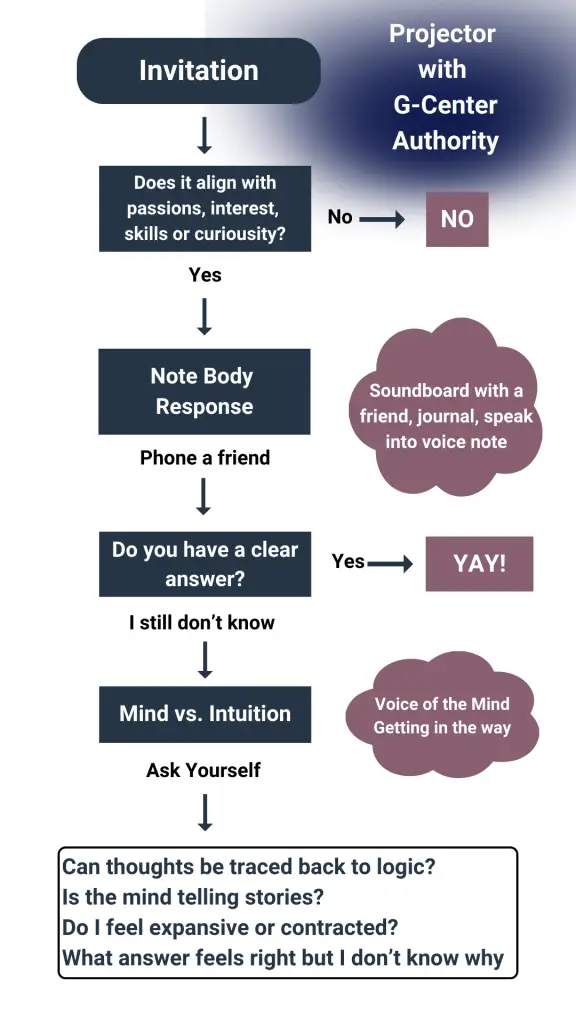
step 1 – decision point
- At the top of this flow chart, we have a triggering event or decision point. Maybe there’s a job opportunity, a job offer, a project you’ve been invited to work on, or an event you’ve been asked if you want to attend.
step 2 – is the opportunity in alignment?
- The first question to ask is, “Does this thing, whatever it is, align with my skill sets, my talents, or my gifts? Does it align with my curiosity? Does it align with my passions and interests?
- If the answer is no, you’re probably going to want to say no to the thing.
- If the answer is yes, the next step is to tune into your splenic authority
step 3 – tap into your g-center authority
When you have G Center authority, it is important to think of your thoughts as a ball of yarn, and when you speak out loud, you are “pulling out your string of thoughts” through your voice. This is why this authority is often called soundboarding intuition. And as a G Center authority person, you will want to have a few trusted friends or family members that you can go to and say, “Hey, I need to talk out this new opportunity that’s come my way”. You are not here to get advice from these other people. They may offer you advice, and you can decide if you actually TAKE the advice.
The goal is to pay attention to two things as you are speaking out loud
- How are you speaking about the thing or opportunity? What words are you using? What energy are you bringing to the conversation? Are you speaking with enthusiasm and high energy? Or are you unsure and low energy? Are you using mostly positive words? Are you using negative words?
- How do you feel physically, in your body, as you are speaking about the situation? Do you feel clear, free, and expansive? Do you feel heaviness, contraction, or tension in your body?
The G-Center sounds like…
- A “YES” sounds like you speaking about a situation with an exciting or optimistic energy.
- A “NO” sounds like you speaking about a situation with a depressed, low, or unsure energy.
Tips for those with G-Center authority:
- Try audio recording yourself – If you don’t have the opportunity for a human soundboard, try audio recording yourself on a voice note as you talk about the opportunity. Not how you feel as you speak out loud. Does this thing feel right to me? And then listen back to yourself, what language are you using? Are you using more negative words? Are you using more positive words? What sort of feelings or emotions are coming out? What is the vibe or the energy that’s being expressed through your voice?
- Try journaling – Grab a piece of paper and free-write. Brain-dump all the thoughts out of your head, including fears, desires, wants, and everything about the opportunity. Then read it back and think, okay, am I seeing more of a positive vibe in this writing? Or is it clear that there’s something about this opportunity that doesn’t feel right to me?
step 3 – clarity or confusion?
After tuning into your splenic authority, you should have clarity on the decision that is right for you.
But let’s say that you’re still not sure. Maybe you aren’t clear on how your authority’s voice shows up. You don’t understand how splenic authority speaks to you, so you don’t have a clear answer.
If you don’t have a clear answer, the next thing you want to ask yourself, “is the voice of my mind clouding out my intuitive voice?”
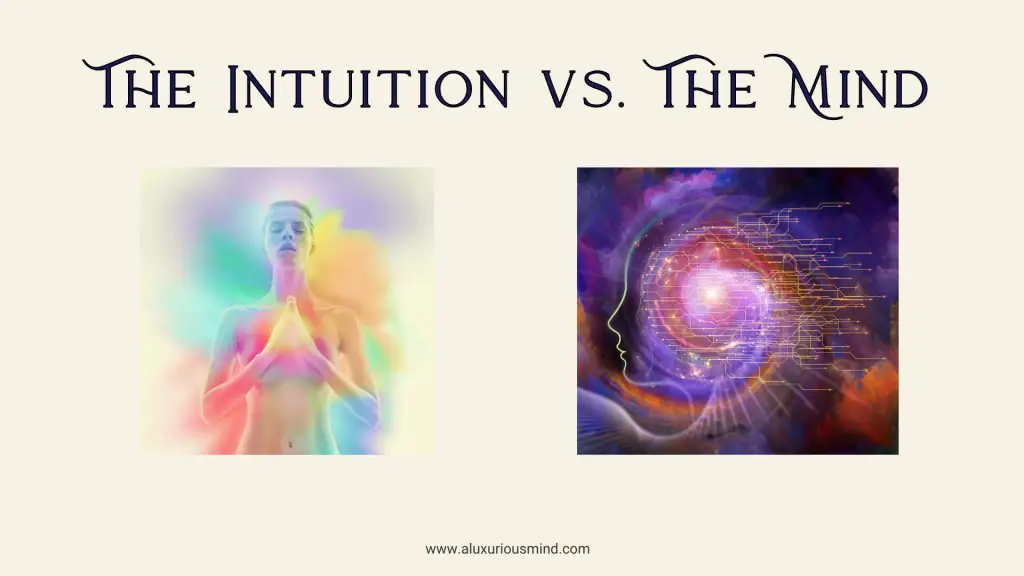
step 4 – mind vs. intuition
How do we tell the difference between our mind and our intuition?
The voice of the mind will be…practical, grounded in logic, and it will tell stories that often sound like the external voices we listen to (e.g., parents, coaches, random people on the internet, etc.).
Whereas, the voice of your intuition will NOT make logical sense.
So what does that look like? In the example of a job opportunity, that is going to look like a voice telling you, “Well, you shouldn’t apply for that job, or you shouldn’t accept that job because you don’t have the right credentials.” Or “You don’t have the right background for that position.”
In an example of being invited to an event, that voice might say, “You shouldn’t go to that event because so and so might be there.” Or “You SHOULD go to this event because there is a social obligation and people are going to be upset if you’re not there.”
You see, the mind tells stories. It tells us that we are not qualified enough, that we are not good enough, or it might not be the right opportunity because it “Doesn’t make enough money.
So why is it important that we NOT allow the mind to make decisions for us? Because that is where the MAGICK HAPPENS!
From a Human Design perspective, the more we listen to that intuitive voice (our authority), the more we free the mind to express its genius in everything we do. The mind should not be controlling where we go, and what decisions we make. In a perfect scenario, we should lean into our intuition and let it guide us through life.
So the more you can learn the difference between the voice of your mind and your intuition, the easier life decisions will become.
Tune into the intuitive voice within, that knowing feeling within you that says, “This is the right decision for me,” even though you can’t provide a logical explanation as to why. It is important to pay attention to the splenic voice that speaks quickly and in the moment. It will say “Just do it” or “No, don’t do it”. Is the thing in question scary exciting (a yes)? Or is it scary? Heck no!
Anytime you are using the word “should,” this is the voice of the mind. In a perfect situation, you want to go with the intuitive hit that feels right but can’t be explained by logic.
step 5 – decide
With practice, this process will become easier over time. At first, it is so difficult to know the difference between the voice of your intuition and the voice of your mind. Lean into it gently.
Lastly, even if life circumstances prevent you from following your intuition in a specific situation, acknowledge it, recognize it, and leverage the wisdom it offers in other ways moving forward.
your authority is just the beginning
Your authority is one of the most important parts of your Human Design, but it works alongside your strategy, profile, centers, and gates. If you’re ready to understand your full design, explore Aligned by Design.
related articles
- Human Design Authority Types – CLICK HERE
- G-Center Authority Explained – CLICK HERE
- G- Center – CLICK HERE
references
- The Definitive Book of Human Design: The Science of Differentiation by Lynda Bunnell and Ra Uru Hu
- Jenna Zoe myhumandesign.com Level 1 – 3 Reader Trainings
disclaimer
As an Amazon Associate I earn from qualifying purchases. Some links on this blog post may be affiliate links that can result in small commissions & help support the site.
