

The Gates of the G Center in Human Design are connected to identity, love, and direction. The G Center reflects your sense of self and the path you’re naturally drawn to in life. The gates within this center represent different expressions of love, purpose, and direction, shaping how you experience identity and the themes that guide your journey.
In this guide, we’ll start with a brief overview of what gates are in Human Design and how they function within the bodygraph. We’ll then explore the role of the G Center and how it influences identity, love of life, and direction. Finally, you’ll find a high-level breakdown of each gate in the G Center, including the traditional gate name, core theme, and examples of both high and low expressions of the energy.
If you’re new to Human Design or want to see how the G Center gates fit into your overall chart, you may want to return to the Human Design Guide, where you can learn how your energy type, strategy, authority, profile, centers, channels, and gates all work together.
Return to the Gates Guide Page to explore other gates in your chart.

the g-center
- The G-Center is the diamond-shaped energy center at the center of the bodygraph chart.
- The Magnetic Monopole lives here in the G-Center. The Magnetic Monopole does one thing: it attracts love and beauty like a magnet. It knows where we are going and why we are here. It is pulling us through time and space, drawing to us the things that are specifically ours to experience in this lifetime. We may not trust this knowing, and our mind starts telling us we need to go after things that are not in alignment with our true self.
- If we honor our unique strategy and authority, we will go exactly where we are destined to go and love who we are supposed to love.
- This energy center is also about identity, love, and direction in life. Love of life and not necessarily romantic love. It is about all of the places that love can come from. When we tap into or use the gifts we have in the G-center, we will feel more love for life and our lives will feel full.
what are the gates in human design?
- The Gates in a Human Design body graph represent the gifts, talents, motivations, energetics, or drives that are consistently available to us. If you DO NOT have a gate activated or colored, it doesn’t mean you never have access to that energy. It just means it’s not a reliable or constant source of energy in your life.
- Everyone has the potential for 26 individual gates to be activated in their bodygraph chart; however, if you look closely, you may find that some gates appear multiple times in the two columns on either side of the chart. This is a common occurrence.
- There are 64 Gates in a bodygraph chart, and each gate has a theme that is related to the 64 I Ching hexagrams. If you would like a deeper understanding of the gates, I highly recommend deep diving into the Chinese I Ching hexagrams.
- Lastly, it is worth noting that there are MANY layers to all aspects of the chart, including the gates. This article is intended to be a high-level summary.
the gates in the g-center
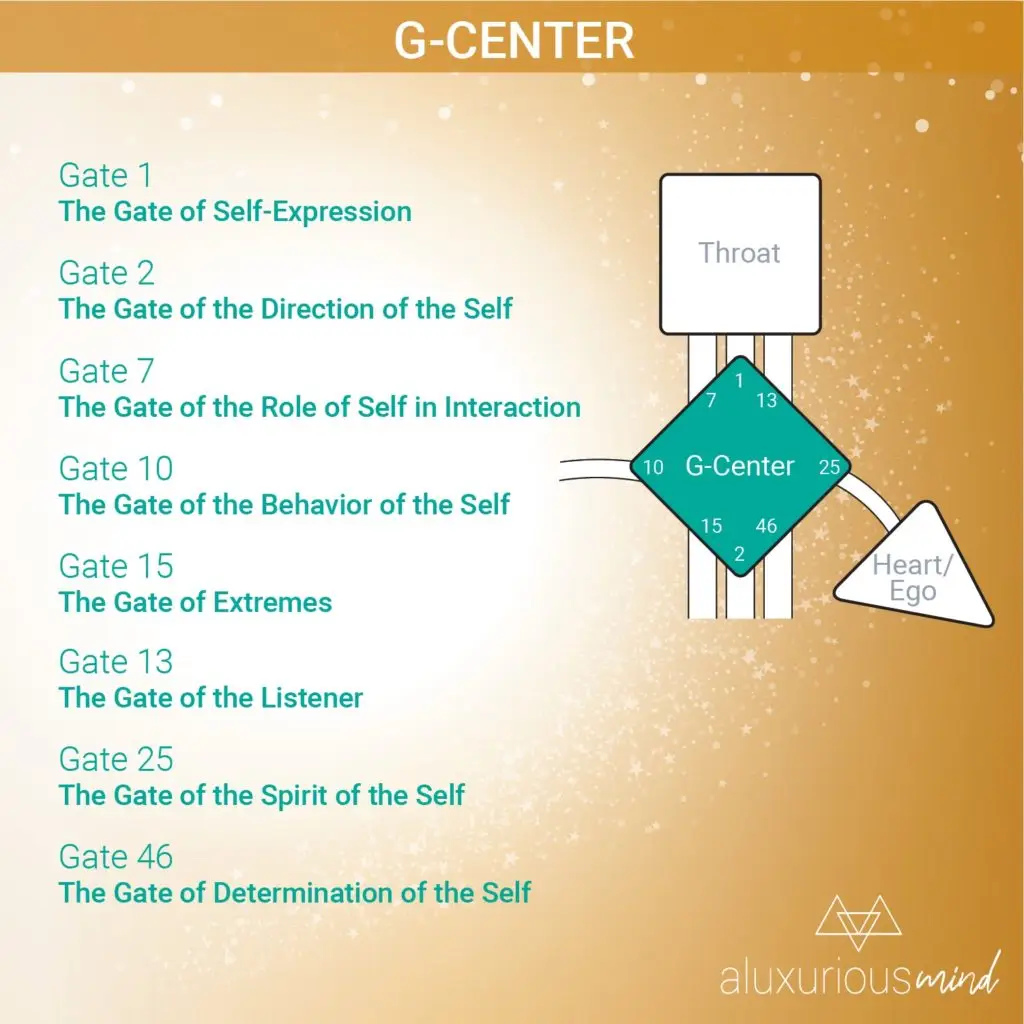
gate 1
- Traditional Name – Gate of Self-Expression
- Theme – Creating newness for the sake of individual self-expression
- High Expression – Fully expressing themselves, tapping into their creativity, and making an impact through contribution.
- Low Expression – Not fully expressing themselves, they feel stuck, melancholy, and afraid of failing in their purpose.
- CLICK HERE for an article dedicated to Gate 1
gate 2
- Traditional Name – Gate of the Direction of the Self
- Theme – A knack for taking a vision and turning it into reality
- High Expression – Very receptive, supportive individuals who have the vision to follow their unique path. May be good at managing resources.
- Low Expression – They may resist support from others, experience burnout, compromise their own path forward, and/or engage in careless spending.
- CLICK HERE for a dedicated article on Gate 2
gate 7
- Traditional Name – Gate of the Role of Self in Interaction
- Theme – Logical power behind the throne.
- High Expression – This person has a vision for a future direction and can be influential in leading others to make it happen.
- Low Expression – Leading for attention or ego and not in service to others.
- CLICK HERE for an article dedicated to Gate 7
gate 10
- Traditional Name – Gate of the Behavior of the Self
- Theme – Having a love of life and loving their own life.
- High Expression – Someone who is meant to help others love life by loving their own. It is the embodiment of self-empowerment at its best.
- Low Expression – Feeling disempowered or playing the victim.
- CLICK HERE for an article dedicated to Gate 10
gate 13
- Traditional Name – Gate of the Listener
- Theme – Listening and collecting stories.
- High Expression – This person is like a bard, collecting the stories and retelling them as wisdom to share.
- Low Expression – Getting stuck in old beliefs or stories
- CLICK HERE for an article dedicated to Gate 13
gate 15
- Traditional Name – Gate of Extremes
- Theme – The ability to accept differences, including the extremes of life.
- High Expression – They may feel drawn toward extremes in rhythms or patterns in themselves or others. They may want to find a place in society for the full spectrum of human behavior.
- Low Expression -Trying to force consistency when they are not necessarily designed to operate that way.
- CLICK HERE for an article dedicated to Gate 15
gate 25
- Traditional Name – Gate of the Spirit of the Self
- Theme – The ability to embrace life with a childlike innocence.
- High Expression – This person can move through the world as if everything were new. They do this naturally, and people will see this in them.
- Low Expression – Feeling unworthy of love or being too idealistic.
- CLICK HERE for an article dedicated to Gate 25
gate 46
- Traditional Name – Gate of Determination of the Self
- Theme – Having a love of the physical body and its power
- High Expression – This person can be in the present and honor their physical body and the power it holds.
- Low Expression – Not taking care of themselves physically or obsessing over body issues.
- CLICK HERE for an article dedicated to Gate 46
stop piecing together your human design
Instead of jumping between articles, the Aligned by Design Bundle teaches you how to read your full chart in one clear, easy-to-follow framework.
artist attribution
- Featured image Photo by Denise Jans on Unsplash
references
- The Definitive Book of Human Design: The Science of Differentiation by Lynda Bunnell and Ra Uru Hu
- Jenna Zoe myhumandesign.com Level 1 – 3 Reader Trainings
disclaimer
As an Amazon Associate I earn from qualifying purchases. Some links on this blog post may be affiliate links that can result in small commissions & help support the site.
